
Saffron Rice
1405 Norouz

Our New Year felt like my ex-flatmate’s macaroni bridge. When I was studying my bachelor's in Iran, I lived in a shared flat with an architecture student. Her department hosted a competition called the “Macaroni Bridge”. Within a couple of hours, the students built a bridge out of macaroni, and the one that could hold the most weight was the winner.
On the competition day, she invited me to join her to see the final result. I walked into a studio full of macaroni structures on the long tables. The air was heavy, and students were commenting loudly on each other’s pieces. I spotted my friend standing by her masterpiece, surrounded by her classmates. She was popular in the department, thanks to her taste in fashion. She greeted me with a hug and showed her structure.
“This looks so good, Azizam,” I said in amazement. “How much time did it take?”
Before she could answer, the professor came around the desk. He was carefully loading books on each structure until it shattered. He stopped at my friend’s stand and scanned it for a second.
“This is patched with Tof,” one of the students commented loudly, giggling.
The professor looked at my friend over his brown-framed glasses resting on the tip of his nose.”
“No, Ostad, it will…” The bridge bent under the first book he put on it. He shook his head and moved to the next one.
Our Norouz this year was also held together by Tof.
We circled the Kotti roundabout a couple of times searching for a parking spot. The hasty drivers honking and outnumbered cyclists appearing from right and left, swearing under their breath. When Zaid sent me the address, I couldn’t imagine someone living right by Kottbusser Tor station. With some luck and Noura’s prayers, we landed on a golden spot to park the God damn car. Walking to the place took us another 20 mins to find the entrance of the cramped buildings around Kotti. Google had estimated 2 mins.
“Kotti is the real Berlin,” I said to Noura on the lift to the 5th floor. She came two days ago from Hamburg to spend the Norouz with me.
We exited the lift to a dimmed corridor with many doors on both sides. More than one door was left ajar, but Hayde, the Iranian pop singer, guided us to the right one. Passing through a tiny corridor, we found ourselves in the kitchen full of friends greeting us. The room was a typical WG kitchen. Hand-installed shelves with scattered sketches and postcards stuck wherever they could find a patch of wall. At the end of the long kitchen, a dining table was by the window, opening right to the Kotti-platz. From that point, it looked as if the U-Bahn platform and railroad had locked the roundabout in its arms. A metal roof for Kotti that can hardly be noticed when walking or driving under the station.
On the table, Sofre-Haftseen was set. A sign of Norouz, a collection of seven elements, each symbolizing a wish for the upcoming year.
“Haft-Seen is missing the Seer,” Noura said.
“Yeah, we needed the garlic for cooking, that still counts.” Omid, the host, said, giggling.
“Your WG is so cool, any of your flatmates around?” I said to Omid.
“You should see the upstairs,” Zaid said.
“I have never seen a WG having an upstairs,” Noura said.
Preparing what Zaid had in mind for the New Year meal pinned us all around the table, chopping, peeling, and mincing different ingredients. It was a complicated traditional Iranian dish with different types of nuts and saffron rice. The main concern was whether the food would be eaten before the Tahvil, the moment of the New Year, as there is a saying: For the rest of the year, you will be doing whatever you are doing at Tahvil. Zaid could not guarantee the timing.
“It’s Okaaaaay, is it too bad if we have the food right at Tahvil? It would mean we would be fed next year, ” Zaid said, turning to us sitting around the table impatiently.
He was in a deep discussion with Noura and Omid about the right way to do each step. Now and then, one of them would win the cooking battles with a known comment. “My-mom-always-did-it-like-that.” Everyone in the kitchen follows whatever a mom in Iran has done. In moms we believe.
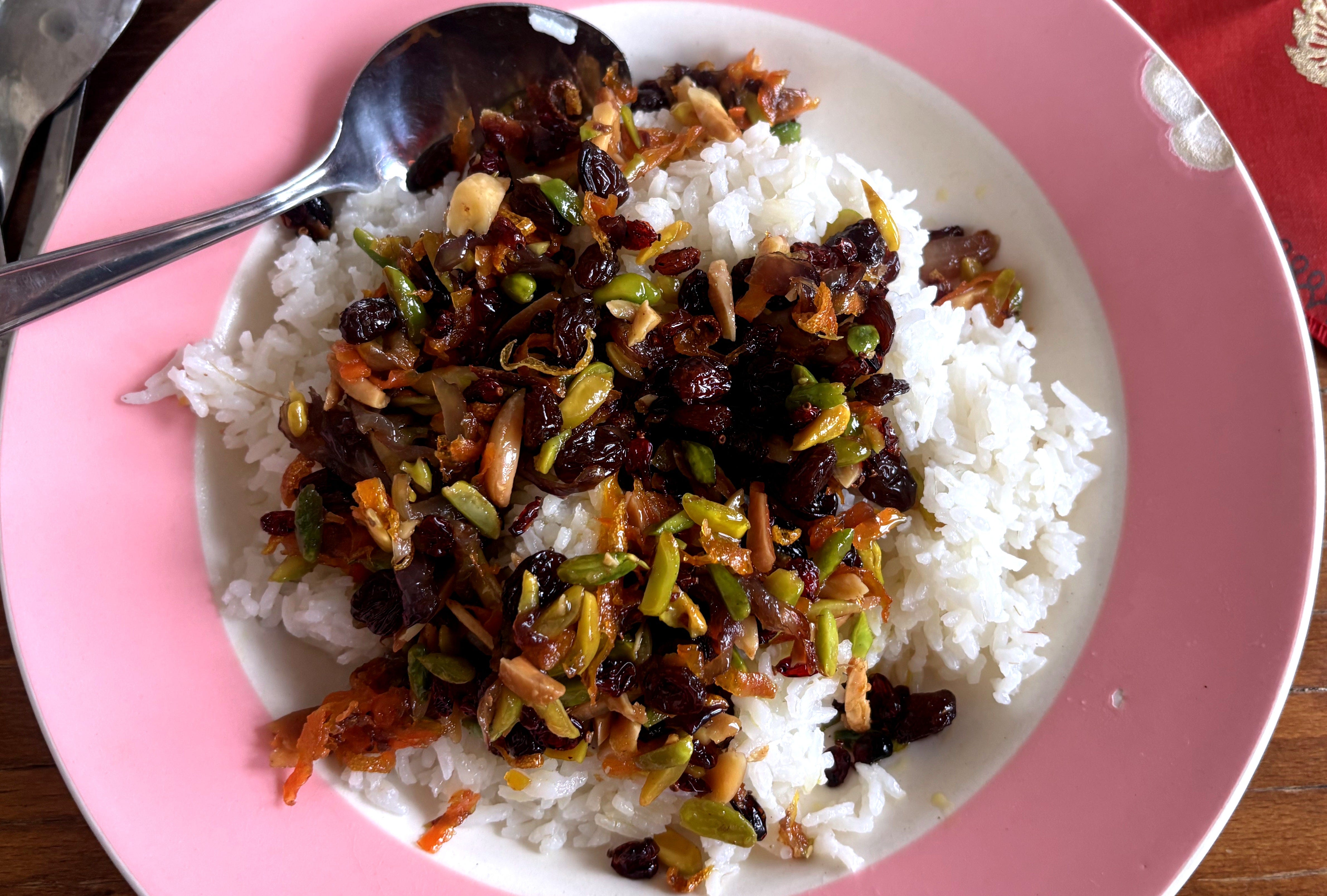
The dish turned out to be one of the best Iranian meals I have ever had, and timing worked out. With our plates empty and our stomachs full, we sat calmly around the table, waiting for tahvil.
On 20 March 2026 — 14:45:59 UTC (about 14:46 UTC). Local time: Tehran: about 18:16 (6:16 PM) _ Berlin: about 15:46 (3:46 PM). The year 1405 started in the Solar Hijri calendar.
“Eydet Mobarak”
“عیدت مبارک”
“Eydet Mobarak”
“عیدت مبارک”
“Eydet Mobarak”
“عیدت مبارک”
Followed by kisses and hugs. We wished that the war in Iran would end in the new year. Zaid read a poem from the book he brought to ask Hafez, the poet, about our wish for the upcoming year. Hafez reassured us that better days will follow. Be patient and believe in faith. Typical Hafez on every occasion.
Traditionally, we call home to wish a Happy New Year. But with the Internet shutdown imposed by the state, the only possible way to connect was to wait for someone to reach us. An expensive landline call from Iran. The call usually didn’t last more than a few minutes, but it was something.
“My sister should call any minute now,” Noura said to Omid and me, staring at her phone on the table, her crossed leg moving absentmindedly.
Others have already moved to the living room. Omid put on some music and left the room to join them. “Jomeh” from Farhad was playing on the speaker. The song was released in honor of the so-called “Dark Friday”. Referring to September 8, 1978, a violent mass shooting. Security forces fired on protesters in Tehran’s protest against the Shah, causing 64 deaths. Those people have marked the day as Dark Friday in history, unaware of the upcoming days in Iran.
I was resting my chin on my hand, staring out the window at Kotti’s platform, following the passing trains through its transparent walls. The smell of saffron was still in the room. The KottiBusser Tor station sign appeared between the arrival and departure of yellow trains. For most of those people loading onto the train, it was a normal Friday. They probably didn’t even know that it was the first day of Spring. They probably had a good Internet connection. The candle on the Sofre-Hafseen was coming to its end like Farhad’s song. Noura’s phone finally rang.
“Salam, Thanks, Maman, Happy New Year to you too.” She said.
“Sure, Maman, yes with Aysan, sure, yes, she is also sending salams,” Noura said and looked at me. I tried not to look at her, but sometimes eyes seek company for swimming.
“Inshallah, Maman inshallah,” her voice broke.
I rubbed her back and turned to the window. Unlike the metal railroads of Kotti, our Norouz was like my flatmate’s macaroni bridge—patched together with Tof, and no amount of saffron could compensate for the war back home.